
Record Retention Guide
How Long Should You Keep Tax & Financial Records?
Not sure how long to hang on to tax and financial documents? You’re not alone. Keeping records for the right amount of time helps protect you in the event of audits, disputes, or questions — without drowning in paper.
Below is a general guideline for business and personal records, plus best practices for storing and safely disposing of documents.
Quick note: These are general recommendations. Certain situations may require longer retention.
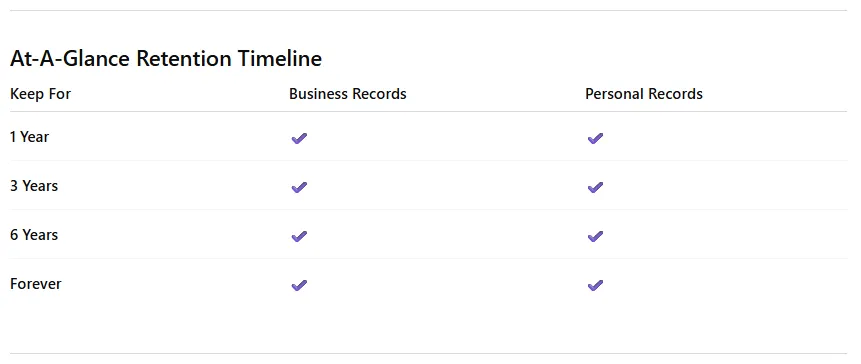
At-A-Glance Retention Timeline
Best Practice: Create a Digital Backup
Keeping a backup set of records is easier than ever — and highly recommended.
Many banks, payroll providers, and insurers already provide electronic statements
Paper documents can be scanned and saved digitally
Store backups on:
External hard drives
Encrypted cloud storage
Secure online backup services
Online backup is often the safest option since files are stored off-site. If a fire, flood, or natural disaster occurs, your records remain protected.
⚠️ Important: Protect Yourself From Identity Theft
Once documents are no longer needed, do not throw them in the trash.
Shred paper documents containing personal or financial information
Securely delete digital files
Avoid recycling unshredded records
Identity theft is real, common, and expensive. Proper disposal matters.
Business Record Retention
Business Documents to Keep for 1 Year
Correspondence with customers and vendors
Duplicate deposit slips
Purchase orders (non-primary copies)
Receiving sheets and requisitions
Stockroom withdrawal forms
Stenographer or internal notebooks
Business Documents to Keep for 3 Years
Employee personnel records (after termination)
Employment applications
Expired insurance policies
General correspondence
Internal audit reports and internal reports
Petty cash vouchers
Physical inventory tags
Employee savings bond registration records
Time cards for hourly employees
Business Documents to Keep for 6 Years*
Accident reports and claims
Accounts payable & receivable ledgers
Bank statements and reconciliations
Cancelled checks
Employment tax records
Expense reports and schedules
Expired contracts and leases
Inventories
Customer invoices
Payroll records and summaries
Sales records
Travel and entertainment records
Vendor and employee payment vouchers
*Records involving bad debt deductions or worthless securities should be kept 7 years.
Business Records to Keep Forever
While not required by law, these documents should be retained indefinitely:
Tax returns and worksheets
CPA audit reports
Corporate formation documents
Financial statements (year-end)
Depreciation schedules
Property deeds and records
Investment confirmations
Legal records and correspondence
Retirement and pension records
Trademarks and patents
IRS audit and revenue agent reports
Personal Record Retention
Personal Documents to Keep for 1 Year
Bank statements
Paycheck stubs (until reconciled with W-2)
Cancelled checks
Monthly retirement or investment statements
Personal Documents to Keep for 3 Years
Credit card statements
Medical bills (for insurance disputes)
Utility records
Expired insurance policies
Personal Documents to Keep for 6 Years*
Supporting tax return documents
Accident reports and claims
Medical bills (if tax-related)
Property improvement receipts
Sales receipts
Wage garnishment records
*Bad debt or worthless security documentation should be kept 7 years.
Personal Records to Keep Forever
Income tax returns and payment records
CPA audit reports
Legal documents
Investment trade confirmations
Retirement and pension records
Important correspondence
Special Circumstances
Some documents should be kept based on life events or agreements:
Car records: Keep until sold
Warranties: Keep for product life
Mortgages / deeds / leases: Keep 6 years beyond payoff or expiration
Property improvement records: Keep until property is sold
Stock & bond records: Keep 6 years after sale
Insurance policies: Keep for policy life
Pay stubs: Keep until W-2 is verified
Not Sure What to Keep?
If you’re unsure whether to keep or discard a document, err on the side of caution — or ask us. We’re happy to help you sort it out.